
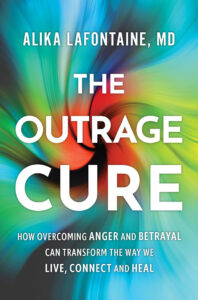
 The world around us is shouting and fighting; our view is distorted by polarizing filters. The realities of patients struggling, providers burning out, and communities left behind are deeply personal and profoundly human problems that cause anger and outrage. Those two emotions are quite different, according to Dr. Alika Lafontaine. In his book, The Outrage Cure, he shares deeply personal examples to help us understand where these emotions come from and how they can be avoided or reversed.
Anger is a cry for help, a signal to others that we have a problem we cannot solve by ourselves. Anger starts with loss, creating an emotional trigger that activates our limbic system and inhibits the executive parts of our brain. During the initial stage, the call for help is constructive in that it seeks interventions and solutions from people in whose competence and credibility we believe.
When our plea is met with dismissal, rejection, or failure, we start to question that competence and credibility. This leads to progressive loss of trust, opportunity, or fairness. As the social contract is progressively violated, as the moral imperative is attacked, anger starts to turn into outrage against “the system” and against those who prefer to keep the status quo rather than bring about change. The angry no longer assume just incompetence, they now assume bad character and systemic failure; they feel betrayed by the decision-makers and “the system.” At this stage, the goal is no longer fixing the problem, it is exposing and punishing those who failed and reinstating or rewriting the social contract.
While outrage spirals, rumination makes it self-sustaining, leading to polarization which can then be amplified further by social media-led echo chambers. Ongoing lack of change can lead to indifference, as people become uninterested in a problem they think cannot be solved. This phase can be dangerous as problems fester and lead to further decline of the issue we tried to solve in the first place.
Although the same process of anger and outrage can evolve on both individual and societal levels, at the higher level, frustration becomes part of a shared identity, part of the culture. Collective anger gains momentum non-linearly and a small tipping point can ignite widespread outrage. Massive outrage can fracture the status quo favoured by the resisting forces that were benefiting from it. Like any complex system, this leads to collapse and reshaping of the existing world.1
As a physician-leader, Dr. Lafontaine shares not only very personal, but also quite practical examples from his personal, professional, and systemic life. By taking us deeply into some of those experiences, he demonstrates honesty, courage, and vulnerability, all traits of strong authentic leadership. As a physician, he gives simple explanations of how biology, physiology, and psychology affect the workings and interactions of the emotional limbic system and the executive, rational parts of the brain. As an indigenous physician-leader, he gives good and respectful insights, not only into the anger and outrage caused by indigenous health-related problems and injustice, but also into some of the problem-solving efforts and reconciliation that he and others have led between the indigenous and the medical communities.
Solutions offered in the book apply more to systemic experiences, but some can also be applied to individual life experiences. The important message is that solving problems is the antidote to anger, before it becomes outrage or indifference. The first step is recognizing and validating anger without aggression or punishment and allowing space for constructive dialogue. Institutions and individuals can then redirect emotional energy toward resolution rather than conflict. As emotional release can precede reason and logic, disruption of anger and outrage should occur in a safe place. Emotional security allows constructive engagement, which requires courage and authenticity, and transition from reactive outrage to productive dialogue. In that space, people also need to move from perception to perspective. Perception is emotional and keeps us stuck in the present. Stepping back or zooming out shows us perspective and connections within the system’s complexity, creating opportunities for problem-solving and unlocking what is possible in the future. Transitioning to perspective also helps place the limbic system in a less overactive emotional mode. One example of such a change in perspective or paradigm shift would be to view the health system’s purpose as health for all, rather than just curing disease.2
Dr. Lafontaine warns about “weaponized outrage,” which leads to a state of permanent outrage and emotional absolutism, even indifference. Such weaponization is engineered by consolidating power and creating division and polarization, ensuring that those in power remain unchallenged. It seeks long-term dominance, ongoing division, and control of the narrative. Once society is sufficiently primed for perpetual outrage, the cycle becomes self-sustaining, and after several cycles, people stop resisting and become silent and indifferent. Although outrage is weaponized to divide, exhaust, and burn out people, indifference is weaponized to ensure obedience. It made this reviewer wonder whether today’s bigger danger to humanity is indifference, preventing us from dealing with issues like climate change and its consequences, the collapse of our health system, food security, poverty, a peaceful and sustainable world, to name a few.
Given Dr. Lafontaine’s vast network and experience clinically, politically, and as a leader, he has unique insights into our health care system, and one might have expected more content on the current shape of that system. But that was not the intent of the book: it was written to give us the foundational tools to recognize, reflect on, and deal with anger, outrage, and indifference in a variety of contexts, including our health care system.
In short, solving problems is the antidote for anger. Outrage can be soothed when we start believing in each other again, opening our hearts to authentic connection, finding others to do the same, and walking toward a place where we can see what else is possible. One of the last sentences in the book deserves to be the last one of this review: “If you put down outrage, your hands will be free to pick up something else…” Let’s free up our hands!