COACHING CORNER
Why emotional intelligence is important for physician leaders

Ellen Tsai, MD, MHSc (Bioethics)
Coaching Corner is a collaboration between the Canadian Physician Coaches Network and the Canadian Society of Physician Leaders to highlight the value of coaching for physician leaders, including how they may effectively use coaching skills in their own interactions. This third article in the series tackles the topic of emotional intelligence. The coach works with the physician leader to identify opportunities to enhance their leadership skills through the lens of emotional intelligence. Using a fictional dialogue, our coach again supports the physician by moving from overwhelm toward clarity, prioritization, and intentional action.
KEY WORDS: physician leaders, coaching, leadership development, professional development, emotional intelligence
Tsai E. Why emotional intelligence is important for physician leaders. Can J Physician Leadersh 12(3): 183-188. https://doi.org/10.37964/cr24817
In the previous article in this series, Dr. Vargas, a newly appointed department chair, had started working with a coach to support them during their transition into a formal leadership role. The coach helped Dr. Vargas prioritize which aspects of the complex situation they were facing — which included navigating interpersonal conflict, staffing instability, and unclear priorities in a changing department — they would first like to tackle. Dr. Vargas also reflected on how they wanted others to see them as a leader and chose an action plan that was aligned with their strengths and values.
We begin with a fictional dialogue between the coach and Dr. Vargas at their next session.
Coach: What would make this conversation valuable for you today?
Dr. Vargas: Since our last session, I met one-on-one with four people as I had planned — two senior surgeons and two newer surgeons. As you may recall, I am concerned about the negative climate in our department and want to smooth out the conflict before any other surgeons decide to leave. The good news is that the conversations with my two senior colleagues went well, and neither of them plan to leave. Unfortunately, my meetings with the two newer surgeons both ended pretty acrimoniously, and I’m worried that I made things worse.
Coach: What would you like to walk away with by the end of our session?
Dr. Vargas: I would like to have a game plan for the next time I meet with the two newer surgeons. I’ve set up another meeting with both of them together for next week. I think my goal should be to repair any damage that I may have caused to our relationship during the one-on-one meetings.
Coach: I sense that having good relationships is important for you.
Dr. Vargas: Yeah, I don’t want to be a leader who simply tells people what to do.
Coach: What do you think you need to address during our session in order to come up with a successful game plan?
Dr. Vargas: I think it would be helpful to explore what I did wrong, and maybe what I could do differently, so that the three of us end up feeling like we want to work together by the end of the meeting.
“We are not thinking beings who feel,
we are feeling beings who think.”
— António Damásio1
This statement aligns with the ground-breaking work of Reuven Bar-On, a psychologist who coined the term “emotional quotient” (EQ) in his 1985 doctoral dissertation.2 This shifted understanding of human capability away from viewing “emotions” and “intelligence” as being contradictory. Although the concept of “emotional intelligence” was popularized by Daniel Goleman’s 1995 bestseller of the same name, the historical roots of this construct can actually be traced back to the nineteenth century.3 Since that time, various psychologists have come to a consensus that the conventional concepts of an “intelligence quotient” (IQ) revolve around a narrow band of linguistic and mathematical skills that predict success in the classroom, whereas “personal” or emotional intelligence is crucial to leading life successfully.4
Today, it is widely accepted that effective leaders need people skills to achieve organizational goals. It is noteworthy that three of the seven habits of highly effective people described by Stephen R. Covey5 are related to interdependence: interpersonal leadership, empathic communication, and creative cooperation. Professionalism and interpersonal skills are also associated with positive impacts on patient health outcomes and physician well-being,6 and a strong correlation has been observed between perceptions of competence and interpersonal skills when it comes to the physician–patient relationship. Furthermore, the risk of receiving medico-legal complaints is associated with negative perceptions by patients about the quality of the interactions with their physician.7
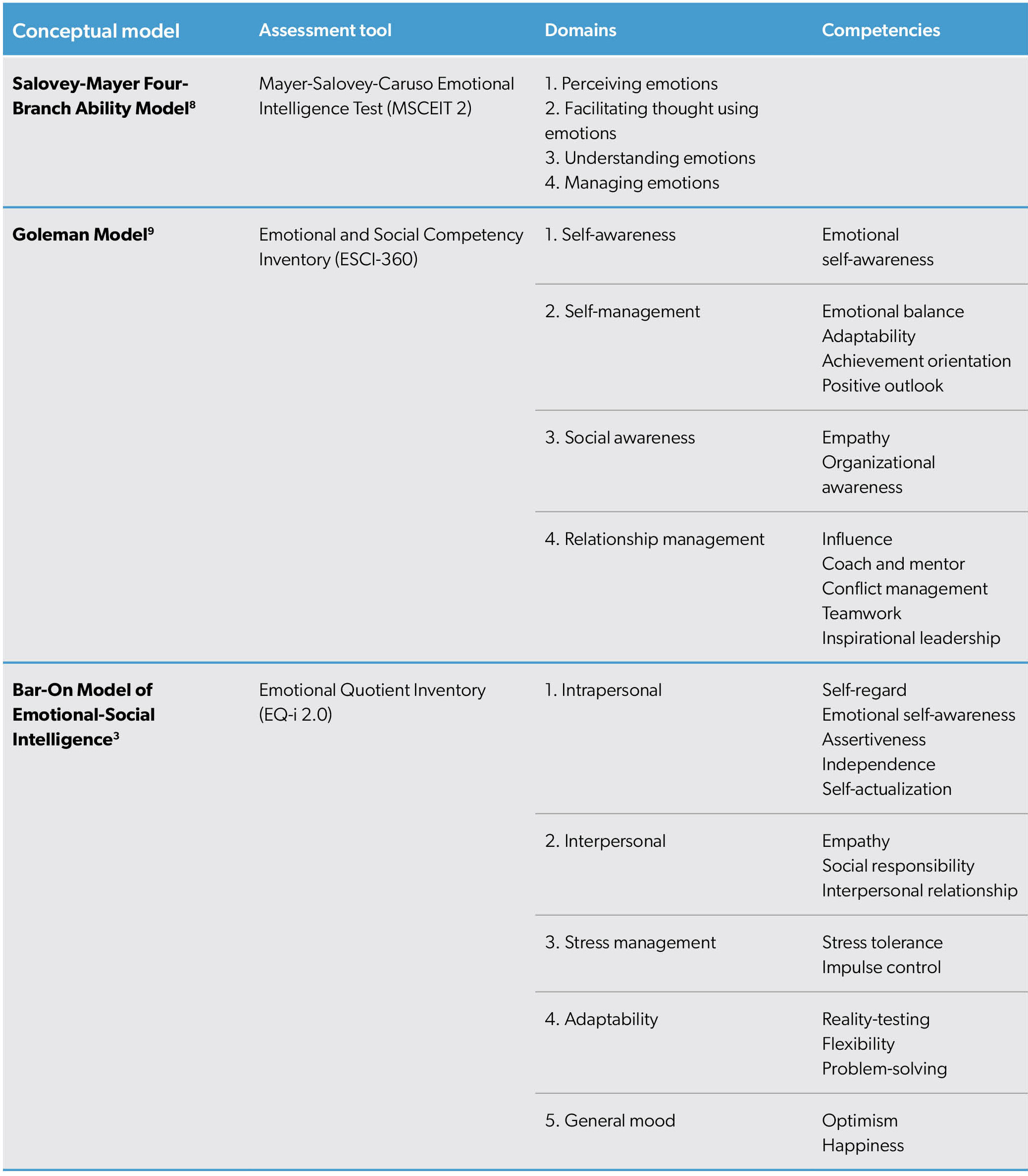
Although a number of frameworks and assessment tools for emotional intelligence exist, there are three major conceptual models (Table 1).
Table 1: The three major conceptual models of emotional intelligence” and should appear at the head of the table
Let’s return to our fictional dialogue to see how awareness of emotional intelligence may support the development of leadership skills.
Coach: Let’s start by exploring what you think went wrong in those meetings.
Dr. Vargas: Although my intention had been to approach the meetings with curiosity, it became clear fairly quickly that the newer surgeons expected me to take their side and were critical that I hadn’t been more assertive dealing with the senior surgeons. I found myself defending my actions rather than asking questions to explore and better understand their perspectives.
Coach: Looking back at those meetings, what — if anything — has become apparent?
Dr. Vargas: I have always considered myself to be an empathic surgeon. However, when I completed an emotional intelligence assessment during a leadership course, I scored lower than I expected on that competency. I still think that I demonstrate empathy well with patients. However, I am probably less empathic when it comes to my interactions with other physicians, particularly if I feel my authority is being challenged.
Coach: How aware are you of your feelings in the moment?
Dr. Vargas: It varies. What I do know is that it often doesn’t go well when I am already feeling irritable or frustrated ahead of time.
Coach: So, what’s the next step?
Dr. Vargas: I probably need to prepare myself before going into the meeting next week with the newer surgeons. I’ve noticed that I feel more in control if I take a few moments to centre myself between meetings or after dealing with a clinical issue. I think that if I feel calm, I’ll have more bandwidth to listen empathically and with curiosity instead of reacting defensively.
They discuss Dr. Vargas’ game plan for leading an open, collaborative meeting with the newer surgeons next week. The coaching session concludes with Dr. Vargas committing to monitor their feelings and emotions several times each day to increase their emotional self-awareness.
Conclusion
Being an effective physician leader requires emotional intelligence, as well as intellectual acumen, to navigate complex relationships and challenging health care decisions. Any of the existing conceptual models allows us to identify and measure various skills and competencies that contribute to emotional intelligence. The overall goal is not to restrict emotions, but rather to use information about emotions intelligently to guide our thinking and actions. Unlike personality traits which may be largely fixed from birth, these skills and competencies can be nurtured and strengthened through education, feedback, and coaching.
“Anyone can become angry, that is easy.
But to be angry with the right person,
to the right degree, at the right time,
for the right purpose, and in the right way,
this is not easy.” — Aristotle
References
Damasio A. Descartes’ error: emotion, reason, and the human brain. New York: Penguin Books; 2005.
Bar-On R. The development of an operational concept of psychological well-being. DPhil thesis. Makhanda, South Africa: Rhodes University; 1985.
Bar-On R. The Bar-On model of emotional-social intelligence (ESI). Psicothema 2006;18(suppl.):13-25.
Goleman D. Emotional intelligence: why it can matter more than IQ. Toronto: Bantam Books; 1995. p. 42-3.
Covey SR. The 7 habits of highly effective people (revised and updated). Toronto: Simon & Schuster; 2020. p. 213-305.
Makary JS. The impact of professionalism and interpersonal skills on patient outcomes and physician well-being: a comprehensive review. Clin Trials Case Studies 2024;3(6). https://tinyurl.com/33ma8p65
Mostafapour M, Smith JD, Fortier JH, Garber GE. Beyond medical errors: exploring the interpersonal dynamics in physician–patient relationships linked to medico-legal complaints. BMC Health Serv Res 2024;24:1003. https://doi.org/10.1186/s12913-024-11457-3
Mayer JD, Caruso DR, Salovey P. The ability model of emotional intelligence: principles and updates. Emotion Rev 2016;8:1-11. https://dx.doi.org/10.1177/1754073916639667
Goleman D. The four domains of emotional intelligence. Sunnyvale, Calif.: LinkedIn Corp; 2022. Accessed 22 Sept. 2026. https://tinyurl.com/y5nycm5n
Author
Dr. Ellen Tsai is a certified executive coach and the current chair of the Canadian Physician Coaches Network. Her professional background includes pediatric critical care and bioethics in an academic setting. She also worked at the Canadian Medical Protective Association, initially as an educator and then as physician lead for the Member Support Program. She is the owner of E Power Coaching and her clients include physicians and other leaders.
Disclosure: Ellen Tsai has completed training and is certified to administer the EQ-i 2.0.
Correspondence to:
ellen@epowercoaching.com