LEADERSHIP EDUCATION AND TRAINING
Beyond the checkbox: Rethinking leadership training in medical education

Eric Michael Hempel, AS, BMLSc, MSc-HSLI
People leadership is a core competency in medicine, yet during undergraduate medical education, it often remains underdeveloped. Although students are exposed to a wealth of clinical practice and social determinants of health content, far less attention is devoted to developing the skills required to guide, empower, and cultivate high-functioning health teams, i.e., people leadership. The consequences can be substantial: hierarchical working cultures, poor staff morale, fragmented supports, and burnout, all of which directly influence health system performance and patient care. Embedding people leadership development meaningfully in the medical school curriculum provides a critical opportunity to reshape workplace culture, strengthen team cohesion, support staff well-being, and ultimately improve patient care. People leadership should not be treated as an optional competency; it is integral to health system resilience, patient care, and the legacy we leave behind.
Key words: leadership, medical education, organizational culture, health human resource, quality improvement
Hempel EM. Beyond the checkbox: rethinking people leadership training in undergraduate medical education. Can J Physician Leadersh 12(3): 175-182. https://doi.org/10.37964/cr24816
Leadership begins with people
In a recent leadership interview, as part of the master of science in health systems leadership and innovation curriculum under the Institute for Health Policy, Management, and Evaluation, a physician executive shared: “When I leave my position or I leave the organization, there’s no medal. There’s no monument they’re erecting. There’s no award named after me, but it’s the people that I leave behind. That is the legacy. So, when I say ‘people leadership,’ I mean talent scouting. Unlocking everyone’s potential and maximizing others” (Hempel E. Unpubl. 2025, Institute for Health Policy, Management, and Evaluation, University of Toronto).
At its core, people leadership is about supporting, developing, and empowering others to reach their potential. This becomes especially important in health care, where providing high-quality patient care is fundamentally a team effort. Physicians, allied health, support staff, and many more work collectively to improve patients’ well-being, be it by sharing knowledge and expertise, designing comprehensive care plans, or guiding smooth patient transitions. As such, interprofessional and integrated care models have become more adopted across health systems in recognition of the value of teamwork and collaboration in providing optimal patient care.1
The 2026 Canadian Conference on Physician Leadership in Montréal, Quebec, explored this concept further, highlighting that positive organizational culture influences patient care just as much as clinical excellence. Patients often notice not only direct interactions with their care providers, but also the way health professionals interact with one another.2 Physicians, wearing multiple hats simultaneously, are uniquely aware of organizational culture. They oversee the clinical care of patients, interact with a variety health professionals to deliver appropriate care, and communicate with upper administration on issues at the front-line.3
An example from British Columbia illustrates the importance of physicians’ role in influencing workplace culture. Multiple emergency department closures across major urban centres prompted a province-wide review of the health care system. Surveys of affected clinicians and staff revealed that respondents felt neglect and burnout after years of experiencing disengaged leadership, as well as unsafe and unsupportive working environments.4 This highlights the urgent need for leaders who care, listen, and advocate for their teams and patients — key qualities of people leaders.
So, if people leadership is so valuable to health system sustainability, how are we preparing our future physicians to become people leaders?
Do as I say, not as I do
Medical school is often described as a marathon. To meet rigorous accreditation standards, curricula are densely packed with numerous learning objectives from clinical medicine to discussions around the social determinants of health, mental health, diversity, equity and inclusion, artificial intelligence, and more. Leadership training has also made its way into the mix, as part of the core CanMEDS Physician Competency Framework5 adopted by the Royal College of Physicians and Surgeons of Canada, emphasizing that leadership involves engagement in shared health system decision-making, collaboration, and continuous improvement. Notably, although people leadership is not explicitly identified in the framework, several of its core elements are present, including leading multidisciplinary teams to implement change, providing mentorship and guidance to help others develop leadership skills, and maintaining positive relationships with other health professionals. CanMEDS also conceptualizes these competencies as developing progressively across the training continuum, with learners assuming increasingly complex leadership responsibilities as they advance.
For undergraduate medical education, the challenge is translating these competencies into learning experiences that prepare students for the progressive leadership responsibilities expected later in training. Historically, leadership training has been provided through workshops and stand-alone lectures; this hasn’t changed much over time.6 For example, at the Temerty Faculty of Medicine, University of Toronto (U of T), training occurs in the following ways: senior leaders host introductory lectures exploring basic leadership principles with medical students, patient advocates attend seminars and share their experiences navigating the health system, and students participate in self-reflection exercises exploring the value of leadership in clinical practice.
Although these resources provide an important foundation for students to build on in future clinical practice, in reality much of this learning remains theoretical, with limited opportunities for students to apply and develop their people leadership skills. Such experiences may instead depend on extracurricular involvement through student councils, clubs, or other initiatives, in which access to longitudinal mentorship and structured feedback can vary. For those seeking guided leadership development and mentorship from experienced leaders in the field, these opportunities fall short. In addition, as medical students balance curriculum requirements with the demands of residency applications, leadership training can become diluted and may often be deprioritized.
This begs the question, what can medical schools do to address this challenge and develop the next generation of clinical leaders?
Leading by example
The COVID-19 pandemic demanded an extraordinary response by health care professionals across the globe. The sharp rise in cases soon overwhelmed testing capacity, forcing jurisdictions to implement lockdown initiatives to help curb the spread. Health systems globally scrambled to keep pace with demand. To cope with the situation, thousands of individuals were hired, with or without a health care background. I was one of them.
As a fresh undergraduate in laboratory medicine, my journey in the health care system started at the BC Centre for Disease Control (BCCDC) under the province’s chief medical laboratory officer (CMLO). Although I had a strong laboratory background, my understanding of health care delivery and the broader health system level was quite limited. As such, I had a few reservations about assuming a role at the BCCDC during a particularly challenging period, worried that the demands of the position might exceed my abilities.
To my surprise, the CMLO, a physician and health care executive himself, who was overseeing BC’s public health labs, mentored me and provided me with a safe space to learn about the organization’s operations, processes, and people. He introduced me to team members, consistently remained responsive to questions, and checked on my well-being on a regular basis. As the pandemic evolved and my tenure with the organization continued, the CMLO looked out for me and provided opportunities to grow my skillset, from smaller data analysis projects to successfully running major provincial initiatives supporting the province’s COVID-19 pandemic response. Despite the ongoing pressures on the labs, he took time to engage with me, reflecting on my mistakes and celebrating my wins. I felt safe, empowered, and proud to be a member of his team.
Later, when I started medical school training at U of T, I used the people leadership lessons I learned at BCCDC to set up an Objective Structured Clinical Examination (OSCE) prep group for our first-year medical school cohort with a few peers. The OSCE aims to assess students’ clinical encounter skills in a standardized manner. Students frequently comment on how stressful it is to properly prepare for these assessments and succeed. Thus, similar to my experiences at BCCDC, students had some initial uncertainty about the OSCE and how to approach it.
Together, my peers and I created a monthly study roadmap that guided our preparation in the months leading up to the exam. We co-designed our schedule with the school’s administration team and held weekly sessions for medical students to attend and practise in a safe space. As leads, we introduced the skills for each session, provided individualized as well as group feedback on the execution, empowered individuals to embrace their strongest performance, and celebrated everyone’s success after completing the OSCE. Years later, students continue to refer to this experience, commenting on how it helped them to not only pass their first OSCE, but also to mentor others in the same way.
Rethinking leadership education
Recreating a global pandemic just to allow executive leaders to mentor medical students in people leadership should not be the vision. In fact, developing standardized learning experiences for students may take away from the variety of leadership philosophies and applications that are desperately needed in the health care system.6
Instead, building on the progressive development approach envisioned in CanMEDS, medical schools should consider a longitudinal, experiential approach to people leadership during undergraduate medical education. This could be achieved by creating leadership opportunities between schools and their local health networks, focused on medical education, quality improvement, and patient safety. By involving students in authentic health initiatives alongside experienced professionals, students could gain hands-on mentorship experience, practise people leadership in an interprofessional care team, and receive structured feedback on their performance, thereby creating a community of practice for leadership development in medical education and beyond.7 Drawing on these principles of leadership development and the experiences described above, Table 1 outlines six core elements of a proposed framework for people leadership development.5-7
Table 1. Longitudinal people leadership development: an experiential framework for undergraduate medical education.
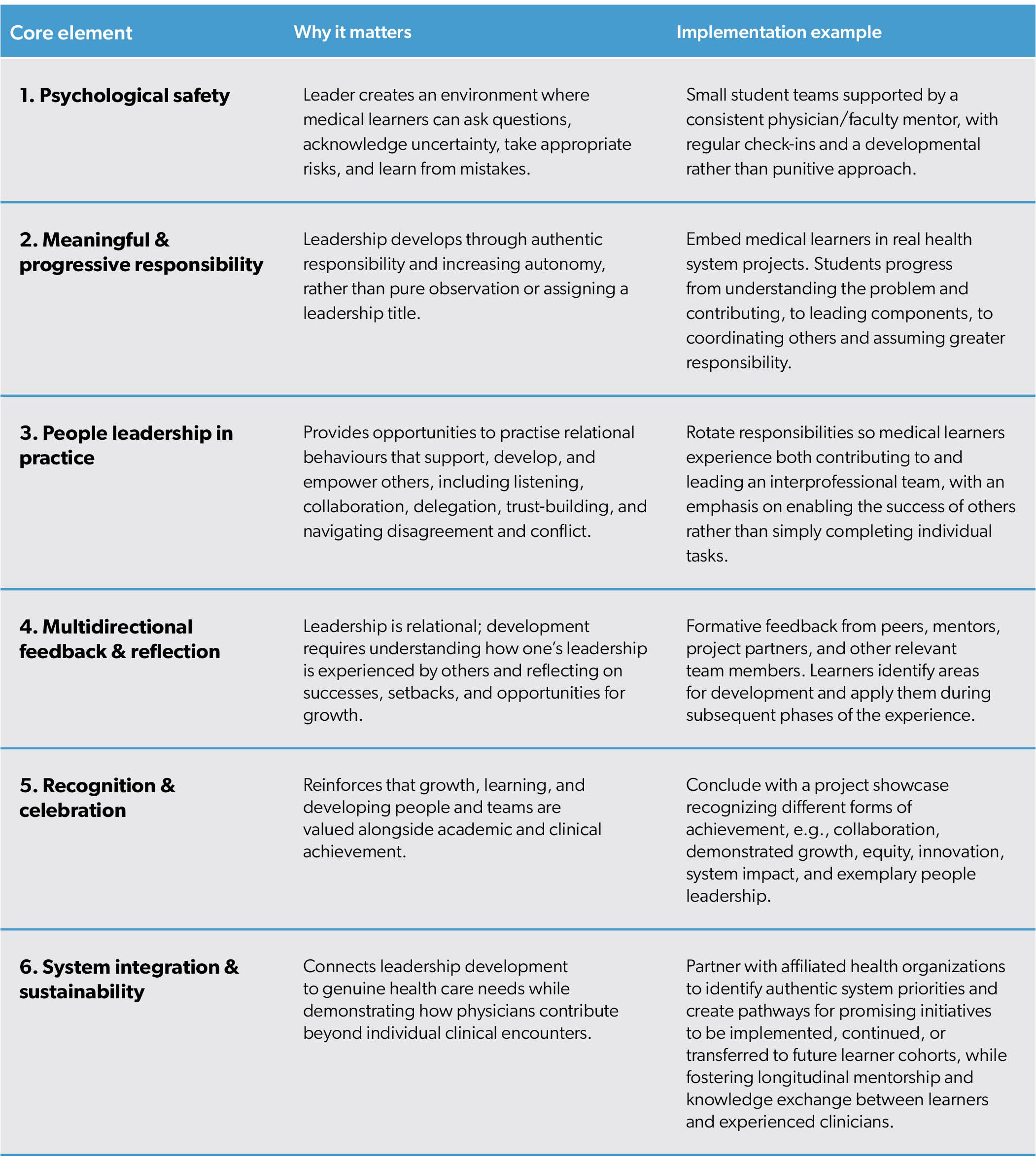
Note: This framework represents the author’s synthesis of principles from existing leadership education literature and the experiences discussed in this viewpoint.
The benefits are numerous. Students would have the chance to practise their leadership skills away from the classroom setting, while also building professional relationships along the way and contributing to meaningful initiatives in their health network, both of which may support their subsequent residency applications and future careers. Medical schools and health networks can, in turn, smooth the transition for students from medical learners to practising clinicians, while potentially strengthening students’ connections to the networks in which they train and promoting homegrown talent. Such relationships may also create opportunities for experienced clinicians to pass along their knowledge, leadership practices, and organizational experience to the next generation of physicians. In this way, people leadership becomes not only about developing today’s teams, but also about building a legacy through the people who follow. Finally, the health care system could benefit from a fresh source of potential and perspectives early on to lead teams and tackle some of the most pressing challenges it currently faces.
Challenges and opportunities
Of course, setting up a leadership program like this is no small feat. It would require consideration of the variety of competing curricular priorities mentioned previously, faculty and health-system capacity, mentorship availability, and institutional buy-in. Moreover, given that classroom sizes across Canadian medical schools have been growing significantly over time, scalability and equity must be considered since opportunities that depend on motivated students seeking out these experiences may not reach all learners equally.8 In terms of assessments, by reducing leadership training to checklists or one-time evaluations, schools risk overlooking the progressive development approach envisioned in CanMEDS. Instead, assessments should use a more longitudinal, experiential approach involving mentorship, multidirectional feedback, and reflection, allowing learners to achieve progressively greater responsibility as they develop their people leadership skills.
Medical schools may not need to build this infrastructure from scratch. U of T’s Quality Improvement Experiential Student Training (QuEST) program, which supports a longitudinal, mentored, and health-system integrated experiential learning, is a testament that this work is possible, at least from a scholarly perspective.9 Building on existing partnerships with hospital networks to facilitate enhanced leadership training would offer a unique opportunity to extend this experiential model toward the deliberate development of people leadership.
Leadership education as an investment in health care
How do we know when we’ve succeeded? As one physician executive put it: “To our front line, we know that we’ve gotten it right when one of our housekeepers can say, ‘My job here is to save lives. If I do the terminal room cleans when a patient leaves after having C. diff and I make sure there are no spores so the next person is safe… then I am saving lives’” (Hempel E. Unpubl. 2025). This is people leadership in action: every team member sees their contribution as integral to patient outcomes.
With a wide range of health care issues on the horizon, from ongoing workforce shortages, funding gaps, public and global health emergencies, to the rise of AI, people leadership will be crucial not only to steer teams through uncertainty, but also to create innovative, resilient, and sustainable, high-performing health care systems. Leadership is not measured by titles. It is measured by the people we help grow. Therefore, leadership education should not begin once physicians become department heads or executives. It should begin on the first day of medical school; not as a checkbox exercise, but as a meaningful skill that needs to be developed and celebrated.
Acknowledgements
I am grateful to Dr. Amir Ginzburg for generously sharing his time and perspectives on people leadership in medicine, which informed the development of this viewpoint. I also thank Dr. Savithiri Ratnapalan, my course director at the Institute for Health Policy, Management and Evaluation, for her encouragement, mentorship, and support in drafting this manuscript. Finally, I thank Drs. Victor Do and Audrey Melanie Hempel for their thoughtful review and feedback on this manuscript.
References
Integrated people-centred care. Geneva: World Health Organization; 2026.
https://tinyurl.com/5h4zn5aa
Guaiana G. People-centred leadership: Four acts of kindness that create better work. Can J Physician Leadersh 2026;12(2):6-8. https://tinyurl.com/s3pvrm7z
Chadwick P. Developing healthcare leaders. IEDP 2023;24 Jan. https://tinyurl.com/mrj49jnx
Carey C, Gangdev S. Province launches review into all health authorities; PHSA, Fraser Health chairs retire. CityNews Vancouver 2025;31 March. https://tinyurl.com/6eyj5tp9
Frank JR, Snell L, Sherbino J, editors. CanMEDS 2015 physician competency framework. Ottawa: Royal College of Physicians and Surgeons of Canada; 2015. https://tinyurl.com/2ks78ctt
Do V. Leadership in medical education: call to action. Can J Physician Leadersh 2020;7(2):72-6. https://doi.org/10.37964/cr24731
Lisevick A, Dreiling J, Chauvin S, Falisi S, Feinn R, Gulati M, et al. Leadership for medical students: lessons learned from a relationship-centered leadership curriculum. Am J Lifestyle Med 2023;17(1):56-63. https://doi.org/10.1177/15598276221106940
Burnell M. Training more doctors is a start. Let’s make sure our health system is ready for them. Commentary. Ottawa: Canadian Medical Association; 2025.
https://tinyurl.com/3k88ecdf
Quality Improvement Experiential Student Training (QuEST) program. Toronto: University of Toronto. https://md.utoronto.ca/mam/quest
Author
Eric Hempel, AS, BMLSc, MSc-HSLI, is a third-year medical student at the University of Toronto, and a recent graduate of the master of science in health systems leadership and innovation program at the Institute for Health Policy Management and Evaluation, Dalla Lana School of Public Health, University of Toronto. He is an emerging clinician-leader with a strong interest in health system innovation, transformation, and sustainability.
Sponsorship and funding:
This work received no external funding. The author declares no financial or non-financial conflicts of interest.
Informed consent: Written informed consent was obtained from the individual quoted in this manuscript for the use of attributed statements. No patient or personal health information is included.
Correspondence to:
eric.hempel@mail.utoronto.ca