HEALTH INFORMATICS
Beyond the algorithm: health informatics and the future of health care AI

Jonas Bambi, MBA, PhD
Elizabeth Borycki, RN, PhD
Andre Kushniruk, PhD
Emma Nsalazi Bambi, MD, MMed

Artificial intelligence (AI) is increasingly presented as a transformative force in health care. Yet many questions now confronting health care organizations, including how to integrate computational recommendations into clinical practice, establish clinician trust, evaluate impact, ensure safety, and sustain adoption, are not new. Clinical decision support systems (CDSS) and earlier generations of health care AI have confronted many of these challenges for decades. This viewpoint argues that the future of health care AI should build on, rather than bypass, the accumulated knowledge of health informatics. Established theories and methods from health informatics, human factors, implementation science, public health, and health systems research provide foundations for designing, evaluating, implementing, and continuously improving AI-enabled interventions. Health informatics professionals can play a pivotal role by connecting clinical problems, information requirements, technology, implementation, evaluation, and organizational learning. Equally important, physicians and other clinicians must be partners throughout the AI lifecycle rather than downstream recipients of technologies developed elsewhere. Bringing these elements together provides a pathway from isolated AI applications toward a learning health system in which data generated through care continuously contribute to knowledge, improvement, and better care.
KEY WORDS: artificial intelligence, health informatics, clinical decision support systems, learning health system, sociotechnical systems
Bambi J, Borycki E, Kushniruk A, Bambi E. Beyond the algorithm: health informatics and the future of health care AI. Can J Physician Leadersh 2026;12(3): 158-168. https://doi.org/10.37964/cr24814
Artificial intelligence (AI) has generated extraordinary expectations in health care. Machine learning can identify patterns within enormous datasets, predict clinical outcomes, process unstructured information, and increasingly generate clinically meaningful content. With these capabilities has come an understandable question: how fundamentally will AI transform health care?
There may, however, be another question that deserves equal attention: what have we already learned about introducing computational intelligence into clinical care, and how can that now be leveraged for implementing AI?
Long before contemporary AI, health informatics researchers and practitioners developed clinical decision support systems (CDSS) intended to place relevant knowledge and patient-specific information in front of clinicians at appropriate points in decision-making. From early expert systems to alerts, reminders, order sets, diagnostic aids, and predictive models, the underlying aspiration has remained remarkably consistent: use information to support better decisions and, ultimately, better outcomes.1,2
Many challenges now associated with AI also have precedents in earlier generations of health information technology: human factors, usability, integration into clinical work, safety, trust, and adoption.3,4 The technology has changed dramatically. Many of the implementation challenges have not.
Therefore, the future of health care AI should not be approached as though health care is encountering intelligent decision support for the first time. We should build on decades of health informatics knowledge while incorporating established theories and methods from human factors, implementation science, public health, health systems research, and related disciplines. Doing so highlights an increasingly important role for health informatics professionals and for physician leaders willing to partner with them.
From clinical decision support to AI-enabled decision support
Early CDSSs were largely knowledge-based. Clinical expertise could be represented through rules and logical relations to generate recommendations, diagnostic suggestions, alerts, or reminders. Systems, such as MYCIN, demonstrated decades ago that computers could represent sophisticated clinical knowledge and support reasoning.1
As electronic health records became widespread, decision support increasingly became embedded within clinical information systems through medication alerts, reminders, order sets, and guideline-based recommendations. At the same time, researchers noted that the quality of the decision rule was only one determinant of success.
A clinically valid alert presented at the wrong point in workflow could become noise. Too many warnings, alerts, and reminders contribute to alert fatigue. Useful information presented without appropriate clinical context may fail to influence clinical decisions or lead to outright rejection of the tool (e.g., ignoring the information provided). Consequently, health informatics researchers identified that CDSS interventions need to be considered within a physician’s sociotechnical work context rather than simply as technological tools that may improve the quality of physician decision-making without accounting for the patient context in which they are applied.5
Contemporary AI greatly expands what is computationally possible. Machine learning can derive complex patterns from data, natural language processing can extract information from clinical narratives, and generative AI can synthesize information and interact with clinicians and patients in increasingly natural ways. Yet greater computational sophistication does not eliminate earlier lessons arising from the evidence-based literature. It makes them more important.
The question is no longer simply, “Can the algorithm predict?” We must also ask: Should this prediction be made? For whom? Using what information? At what point in the care process? How should it be communicated? Who acts on it? How will its consequences be evaluated? AI changes what decision support can do; it does not eliminate what health informatics research has contributed to the clinical decision support literature.
Health informatics as the bridge
Health informatics occupies a distinctive position at the intersection of clinical practice, information science, technology, data, and organizational change. Health informatics professionals can help translate a clinical concern into an information problem and determine whether technology, and specifically AI, is an appropriate intervention. When AI is appropriately implemented, teams of clinicians, data scientists, developers, organizational leaders, quality-improvement teams, privacy specialists, patients, and other stakeholders can work together to solve complex problems.
Such teamwork is critical at the inception of AI projects. Teamwork should not begin after an algorithm has already been developed, but as real-world clinical problems are identified. Health informatics should contribute throughout the lifecycle: defining the clinical problem and information requirements; understanding workflows; assessing available data; contributing to design and validation; planning implementation; evaluating intended and unintended consequences; and supporting continuous improvement.
In this sense, health informatics professionals serve as innovators, translators, integrators, evaluators, and facilitators of system learning in health care organizations. These roles are particularly important in addressing the human-factor challenges associated with health care AI. Kushniruk and Borycki,3 for example, highlight the importance of usability, user experience, clinical workflow, information needs, and human–computer interaction in the design and implementation of AI-enabled systems. These considerations are not peripheral to AI development; they are central to determining whether an AI intervention can be effectively integrated into clinical practice.
For physician leaders, this partnership is particularly important. When working on AI projects, physicians bring to the forefront their knowledge of clinical reasoning, professional responsibilities, patient relationships, clinical context, and the consequences of decisions. Informatics professionals bring complementary expertise concerning information, technology, workflow, interoperability, human-computer interaction, implementation, and evaluation. Neither perspective is sufficient alone, but creating interdisciplinary teams can lead to real-world solutions to difficult clinical problems.
We do not need a new theory for every AI problem
The excitement surrounding AI can create a tendency to treat its design and implementation challenges as unprecedented. Many are not.
Health care and health informatics already include theories, frameworks, and methods for understanding why technologies succeed or fail. Sociotechnical approaches emphasize interactions among technologies, people, workflow, organizational structures, and policies.5 Human-factor approaches examine cognitive workload, usability, information presentation, clinical reasoning, and human-technology interaction.3 Implementation frameworks, such as Consolidated Framework for Implementation Research (CFIR), help examine interventions, implementation settings, individuals, and processes,6 while Non-adoption, Abandonment, Scale-up, Spread, and Sustainability (NASSS) draws our attention to challenges surrounding adoption, scale-up, spread, and sustainability.7
Public health and health systems perspectives add another important dimension. Health care data reflect not only disease but also access to services, clinical decisions, documentation practices, organizational structures, social circumstances, and existing inequities. AI systems trained on these data may, therefore, learn patterns shaped by the health care system and its context, rather than by the underlying clinical phenomenon alone.
These perspectives serve complementary purposes. Human factors and sociotechnical approaches can inform what and how we design. Implementation science can help explain how an intervention becomes embedded and sustained in practice. Public health and health systems perspectives can help us understand the context producing both the clinical problem and the data from which AI learns.
Taken together, these theories and frameworks help us move from asking, “What can we predict from the data we have?” toward, “What information and knowledge do we need to improve this decision?”
Evaluation must extend beyond algorithmic performance
Accuracy, sensitivity, specificity, discrimination, and calibration are necessary for evaluating many AI models. However, they are not sufficient for determining whether an AI intervention should become part of health care.
Consider a model with excellent discrimination. If its recommendation arrives after the clinical decision has been made, is it effective? Is it safe to apply? Can clinicians override it when appropriate, and if they systematically do so, why? If it increases workload, does its benefit justify that burden? If performance differs across populations, what are the equity implications, and how should those differences be addressed?
Thus, health care AI requires evaluation across technical performance, clinical effectiveness, usability and workflow, implementation, safety, equity, organizational impact, sustainability, and unintended consequences.
Health informatics already provide methods that can support this broader evaluation. Kushniruk and Borycki,3 for example, describe a staged user-centred approach progressing from laboratory usability testing to clinical simulation and, subsequently, to “near-live” testing under increasingly realistic conditions. This recognizes that successful AI implementation depends not simply on what an algorithm calculates, but on what happens when clinicians interact with it under real clinical conditions.
To understand how these human-factors considerations can affect implementation, consider an AI-enabled clinical decision support tool designed to identify patients at risk of clinical deterioration. The model may accurately identify a high-risk patient, but its clinical value depends on how that prediction is integrated into practice. If the alert is presented after the clinician has already assessed the patient, interrupts the clinician repeatedly, provides insufficient information to understand the basis or significance of the prediction, or does not clearly indicate what action should follow, a technically accurate prediction may provide little clinical benefit. Human-centred evaluation can identify these problems before widespread implementation by examining when and how the alert should appear, how clinicians interpret and respond to it, and how it affects existing workflows.
Safety provides a particularly important illustration of why evaluation must extend beyond algorithmic performance. Borycki and Kushniruk4,8,9 draw on the concept of technology-induced error — errors arising through technology design and development, implementation and customization, interactions with work processes, and interfaces among information systems. AI may, therefore, introduce new types and patterns of error through interactions among technology, clinicians, information, and workflow. Importantly, some may emerge only when AI is introduced into complex real-world health care workflows, reinforcing the need for evaluation beyond controlled development and testing environments.
The point is not that every AI initiative must employ every existing framework. Rather, health care and health informatics already possess a substantial body of theories, frameworks, and methods that can inform the design, implementation, evaluation, and sustained adoption of AI-enabled solutions, while also guiding the selection of approaches appropriate to the problem and context. AI presents new capabilities and challenges, but it does not require us to start from scratch. The opportunity exists to build on what we already know while adapting these approaches to the unique characteristics of AI.
Clinicians must be partners, not end users
Too often, clinicians enter technology development near the end, as “users” expected to adopt a completed solution. By then, fundamental decisions about the problem, data, outcomes, workflow, and interface may already have been made. Clinician partnership should begin much earlier.
Physicians and other clinicians can help determine whether the problem is clinically important, whether AI is appropriate, whether predicted outcomes are meaningful, whether available information represents the clinical situation, and whether a recommendation could realistically influence care. Their participation should continue through design, validation, workflow integration, implementation, evaluation, and refinement.
This does not mean clinicians must become machine-learning engineers. It means clinical expertise must remain inside the AI lifecycle rather than being consulted only at its boundaries.
For physician leaders, this creates an important responsibility: their role in AI is not simply to approve or champion adoption. It is to help shape what is built, why it is built, how it enters clinical practice, and how its consequences are judged.
From AI implementation to a learning health system
Successful implementation and adoption of AI should not be the endpoint. The broader opportunity is to integrate AI into a learning health system that continuously uses data generated through care to create knowledge, inform practice, evaluate outcomes, and generate further learning.10,11 AI could accelerate this cycle, but deploying predictive models throughout an organization does not by itself create a learning health system.
The critical ingredient is the learning loop. We propose viewing AI-enabled clinical decision support as a lifecycle: Clinical problem → Information requirements → Theory-informed design → AI/CDSS development → Human-centred evaluation → Clinical implementation → Real-world evaluation → Learning and adaptation. Health informatics, clinician partnership, and patient and health-system context span the entire lifecycle (Figure 1).
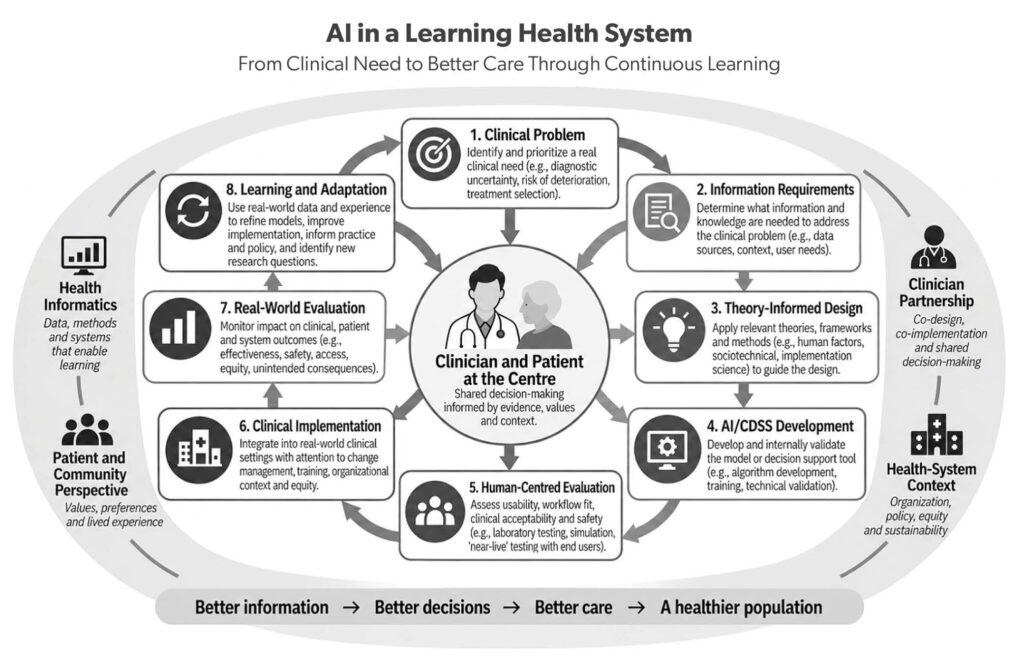
The process begins with a clearly defined clinical problem (1), followed by identification of the information and knowledge requirements (2). Relevant theories and frameworks then guide the design (3), leading to the development and internal validation of the AI/CDSS solution (4). Human-centred evaluation (5) assesses usability, workflow fit and safety before real-world implementation (6). Once in clinical use, real-world evaluation (7) examines the impact on patients, clinicians, and the health care system. Finally, new data and experience inform learning and adaptation (8), refining the solution and generating new research questions. Health informatics, clinician partnership, and patient and health-system context span the entire lifecycle, ensuring that AI is developed and used in ways that are clinically relevant, safe, equitable and sustainable.
Crucially, this is not a linear technology-development pipeline. Learning and adaptation feed back to earlier stages. Evaluation may reveal that the original problem was incorrectly formulated, essential information is missing, workflow has changed, or an intervention creates unintended consequences. Those findings should alter the intervention, and sometimes the information system itself.
AI-enabled CDSSs can, therefore, be understood not as finished products moving from development to deployment, but as components of continuously learning sociotechnical systems.
What can machine learning learn from health care data?
Research led by Bambi and colleagues12-14 has repeatedly returned to a deceptively simple question: What can machine learning actually learn from health care data?
Health care datasets are representations of interactions between patients and health care systems, not complete representations of patients themselves. A patient’s apparent trajectory may reflect disease progression, but also access to care, service availability, referral pathways, organizational boundaries, documentation practices, and social circumstances. Increasing algorithmic sophistication cannot create important information that was never captured.
This observation has informed an emerging program of research on a Target Information Architecture for Dependable Knowledge Construction in Intelligent Systems. One premise is that AI development should begin by identifying the information required to understand and support the health care problem rather than whatever data happen to be available.
This highlights the difference between a data-first question — “What can machine learning learn from the data we have?” — and an information-first question — “What does the health care system need to know to understand and improve this problem, and do our data adequately represent that information?”
The second question requires clinical knowledge, health informatics, theories of the phenomenon being studied, understanding of the health care system, and engagement with those providing and receiving care. It may also reveal that the appropriate response is not simply a better algorithm: the system may need different information, improved interoperability, redesigned electronic health record documentation interfaces, or connections among information currently fragmented
across settings.
Information gaps themselves then become opportunities for system learning and improvement. AI becomes part of a larger learning architecture rather than an isolated prediction engine.
A call to action for physician leaders and health informatics professionals
AI presents health care with remarkable new capabilities. Technological novelty, however, should not lead us to abandon what health informatics has already learned. Decades of CDSS research have taught us that decision support succeeds or fails within clinical workflows and sociotechnical systems. Human-factor and safety research show the importance of understanding interactions between clinicians and technology. Implementation science provides methods for understanding adoption and sustainability. Public health and health systems research remind us that health care data emerge within complex environments. The opportunity is to bring these traditions together.
Health informatics professionals can bridge algorithms and health care systems. Physicians and physician leaders can ensure that clinical purpose, professional judgement, patient needs, and system realities remain central. Researchers, data scientists, patients, organizational leaders, and other stakeholders complete the partnership.
The next chapter of health care AI should, therefore, be less about asking whether AI can transform health care and more about determining how health care can responsibly learn with AI. We are not starting from zero. The theories, methods, and lessons developed through decades of health informatics provide much of the foundation required. The future of health care AI will not be determined by algorithms alone. It will be determined by whether we can build health care systems capable of learning with them.
References
Shortliffe EH, Cimino JJ, Chiang MF, editors. Biomedical Informatics: Computer Applications in Health Care and Biomedicine. 5th ed. Cham, Switzerland: Springer; 2021.
Sutton RT, Pincock D, Baumgart DC, Sadowski DC, Fedorak RN, Kroeker KI. An overview of clinical decision support systems: benefits, risks, and strategies for success. NPJ Digit Med 2020;3(1):17. https://doi.org/10.1038/s41746-020-0221-y
Kushniruk A, Borycki E. The human factors of AI in healthcare: recurrent issues, future challenges and ways forward. In: Househ M, Borycki E, Kushniruk A, eds. Multiple perspectives on artificial intelligence in healthcare. Cham, Switzerland: Springer; 2021. pp. 3-12. https://doi.org/10.1007/978-3-030-67303-1_1
Borycki EM, Kushniruk AW. The safety of AI in healthcare: emerging issues and considerations for healthcare. In: Househ M, Borycki E, Kushniruk A, eds. Multiple perspectives on artificial intelligence in healthcare. Cham, Switzerland: Springer; 2021. pp.13-22. https://doi.org/10.1007/978-3-030-67303-1_2
Sittig DF, Singh H. A new sociotechnical model for studying health information technology in complex adaptive healthcare systems. Qual Saf Health Care 2010;19(suppl 3):i68-74. https://doi.org/10.1136/qshc.2010.042085
Damschroder LJ, Aron DC, Keith RE, Kirsh SR, Alexander JA, Lowery JC. Fostering implementation of health services research findings into practice: a consolidated framework for advancing implementation science. Implement Sci 2009;4(1):50. https://doi.org/10.1186/1748-5908-4-50
Greenhalgh T, Wherton J, Papoutsi C, Lynch J, Hughes G, Hinder S, et al. Beyond adoption: a new framework for theorizing and evaluating nonadoption, abandonment, and challenges to the scale-up, spread, and sustainability of health and care technologies. J Med Internet Res 2017 Nov 1;19(11):e8775. https://doi.org/10.2196/jmir.8775
Borycki EM, Kushniruk AW. Health technology, quality and safety in a learning health system. Healthc Manage Forum 2023;36(2):79-85. https://doi.org/10.1177/08404704221139383
Borycki EM, Kushniruk AW. Application and use of cognitive socio-technical theory. Stud Health Technol Inform 2026;334:88-92. https://doi.org/10.3233/shti260022
Friedman CP, Wong AK, Blumenthal D. Achieving a nationwide learning health system. Sci Transl Med 2010;2(57):57cm29. https://doi.org/10.1126/scitranslmed.3001456
Friedman CP, Rubin JC, Sullivan KJ. Toward an information infrastructure for global health improvement. Yearb Med Inform 2017;26(1):16-23. https://doi.org/10.15265/iy-2017-004
Bambi J, Santoso Y, Sadri H, Moselle K, Rudnick A, Robertson S, et al. A methodological approach to extracting patterns of service utilization from a cross-continuum high dimensional healthcare dataset to support care delivery optimization for patients with complex problems. BioMedInformatics 2024;4(2):946-65.
https://doi.org/10.3390/biomedinformatics4020053
Bambi J, Santoso Y, Moselle K, Robertson S, Rudnick A, Chang E, et al. Analyzing patterns of service utilization using graph topology to understand the dynamic of the engagement of patients with complex problems with health services. BioMedInformatics 2024;4(2):1071-84. https://doi.org/10.3390/biomedinformatics4020060
Bambi J, Dong GY, Santoso Y, Moselle K, Dugas S, Olobatuyi K, et al. Patterns of service utilization across the full continuum of care: using patient journeys to assess disparities in access to health services. Knowledge 2024;4(2):252-64.
https://doi.org/10.3390/knowledge4020013
Authors
Jonas Bambi, MBA, PhD, is an assistant professor in the School of Health Information Science at the University of Victoria. Previously, he spent two decades in health care IT, holding technical and leadership roles in clinical systems, systems integration, and project management, most recently serving as codirector of applied health data analytics. His research focuses on health informatics, health care data analytics, and artificial intelligence.
Elizabeth Borycki, RN, PhD, is a professor in the School of Health Information Science and director of the Global Lab for Digital Health and AI Innovation at the University of Victoria. She is a Michael Smith Health Research BC Health Professional Investigator.
Andre Kushniruk, PhD, is a professor in the School of Health Information Science at the University of Victoria. He has published widely in the areas of usability engineering and human factors in health care IT.
Emma Nsalazi Bambi, MD, MMed, is a pediatrician and pediatric hematologist-oncologist, who formerly practised at LifeCare Hospitals, Kenya. He recently completed a clinical fellowship in transfusion medicine at McMaster University in Hamilton, Ontario.
Correspondence to: jonasbambi@uvic.ca