
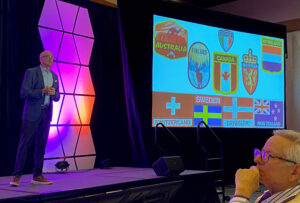
 In his keynote talk focused on physician leadership and organizational culture, Dr. Stephen Swensen presented a compelling argument for “people-centred kind leadership” as a foundational strategy for improving health care systems, staff well-being, and patient outcomes. Drawing from research, international examples, and personal anecdotes, the talk emphasized that kindness, agency, belonging, and positive organizational culture are not superficial ideals, but evidence-based determinants of organizational effectiveness and human flourishing.
Swensen began with a story about a health care executive whose son underwent a kidney transplant in one of her own hospitals. Although the procedure was clinically successful, she concluded that “there was no love in the system.” This observation became the basis for a broader critique of contemporary health care culture. Swensen argued that health care has drifted away from compassion, camaraderie, and meaningful human connection, contributing to rising rates of burnout, loneliness, anxiety, and disengagement among both clinicians and patients. He stressed that healing environments require not only technical competence, but also kindness, respect, and emotionally healthy teams.
Drawing on organizational research, epidemiology, psychology, and health care experience, Swensen structured his presentation around five interconnected dimensions of well-being and leadership: agency (“I choose”), mattering (“I matter”), belonging (“I belong”), compassion (“I care about people”), and optimism (“I choose positive”). He presented these dimensions not as abstract ideals, but as evidence-based determinants of organizational performance, staff well-being, and patient outcomes.
The first dimension, agency, focused on autonomy and control over work. Swensen reviewed evidence showing that individuals with greater workplace agency experience lower burnout, better health outcomes, and greater professional fulfillment. He highlighted examples, such as the Dutch home-care model Buurtzorg, in which self-managed nursing teams operate with minimal hierarchy, and Mayo Clinic leadership structures emphasizing shared governance and physician leadership. He also described the “listen-sort-empower” approach, in which leaders identify operational frustrations or “pebbles in the shoe” by listening directly to frontline staff and empowering them to solve local problems.
The second dimension, mattering, explored meaning and purpose in professional life. Swensen emphasized that individuals perform better and remain healthier when they understand why their work matters. He described a Mayo Clinic sterilization team whose work area displayed the statement, “This is why people are alive,” reflecting their understanding that patient outcomes depended on their unseen contributions. He also reviewed research showing that physicians who spend at least 20% of their professional time engaged in personally meaningful work experience substantially lower burnout rates.
Belonging, the third dimension, focused on social connection and community. Swensen reviewed evidence from social epidemiology, including studies of the Italian–American community of Roseto, Pennsylvania, where strong communal bonds were associated with lower cardiovascular disease and increased longevity. He emphasized the importance of mentorship, collegiality, shared meals, and intentional workplace communities in health care organizations. He described Mayo Clinic initiatives involving interdisciplinary “houses” and shared meal programs that improved morale, social connectedness, and professional satisfaction.
The fourth dimension, compassion, addressed kindness toward both others and oneself. Swensen argued that kindness improves not only psychological well-being but also physiological health. He discussed leadership behaviours associated with effective organizational cultures, including listening, appreciation, mentorship, inclusion, and transparent communication. He also emphasized physician self-compassion, noting that health care professionals frequently demonstrate harsher self-judgement and poorer self-care than workers in many other professions.
Finally, under optimism, Swensen examined the role of positive affect, resilience, and hopeful leadership. He reviewed evidence linking optimism to increased longevity, improved well-being, and stronger organizational cultures. Referencing Viktor Frankl and Nelson Mandela, he argued that individuals retain the ability to choose constructive attitudes even under difficult circumstances.
Swensen concluded that health care leaders must intentionally cultivate cultures grounded in trust, kindness, agency, and human connection if health care systems are to remain sustainable for both patients and professionals.