

COACHING CORNER
What is coaching?

Ellen Tsai, MD, MHSc (Bioethics)
Coaching Corner is a collaboration between the Canadian Physician Coaches Network and the Canadian Society of Physician Leaders to highlight the value of coaching for physician leaders, including how they may effectively use coaching skills in their own interactions. In this first article of the series, we begin the journey of a physician leader as they explore how non-directive coaching differs from other resources that can support them in navigating the challenges of their new leadership role.
KEY WORDS: physician leaders, coaching, mentoring, professional development
Tsai E. What is coaching? Can J Physician Leadersh 2026;12(1): 43-47. https://doi.org/10.37964/cr24805
Dr. Vargas recently became chair of the orthopedics department at a large community hospital. The department has gone through significant upheaval. Two of the surgeons left the hospital last year because of dissatisfaction with changes to operating room allocation and call schedule distribution. They have been replaced by three recent graduates who have been openly critical of the surgical techniques of their more senior colleagues. The operating room has seen significant staff turnover, which began during the COVID pandemic, and vacant positions remain to be filled. Dr. Vargas has been in the department for 15 years and is well respected for their surgical and interpersonal skills. Dr. Vargas is excited about this leadership opportunity and has registered for a few leadership development workshops. However, Dr. Vargas feels very unsure about how to best prioritize and navigate the specific issues at their hospital.
The CanMEDS role of Leader indicates that all physicians should be engaged in shared decision-making for the operation and ongoing evolution of the health care system, noting that physicians function “as individual care providers, as members of teams, and as participants and leaders in the health care system locally, regionally, nationally, and globally.”1 Yet despite these expectations, competencies related to the Leader role generally receive less attention during postgraduate training than those related to other CanMEDS roles such as Medical Expert and Collaborator.2
A qualitative study by Lüchinger and colleagues3 explored physicians’ perceptions and experiences regarding leadership. They found that participants ascribed their negative reactions toward leadership and management “to the fact that they felt ill-prepared to endorse such roles and had little or no training in this field, regardless of their level of hierarchy or clinical experience.” Chairpersons especially expressed “the feeling of being between a rock and a hard place between higher governance and their team.”
What resources are available to physicians when they take on formal leadership opportunities?
The maxim “see one, do one, teach one” in clinical medicine, which has largely been set aside with the development of competency-based educational frameworks, seems equally inadequate in the context of physician leadership. However, given that many new physician leaders lack formal training when they first take on leadership responsibilities, they often end up relying on guidance from their own role models or they learn through a process of “trial and error.”
Dr. Vargas speaks to one of their colleagues, who suggests reaching out to a senior leader to see if they would be willing to act as a mentor. Dr. Vargas had heard about peer coaching for surgeons and is wondering how leadership coaching is different from peer coaching, mentorship, and consulting (Table 1).
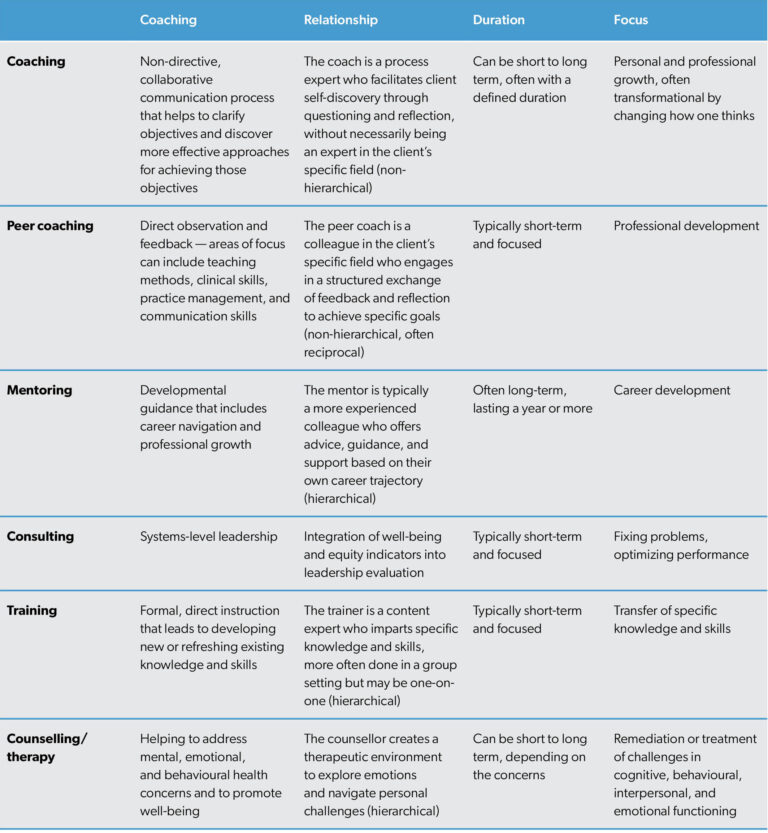
There is accumulating evidence that coaching is an important resource for physicians. Not only does coaching facilitate personal growth through a reflective learning mindset, but gaining clarity and alignment about one’s values and purpose also contributes to professional satisfaction, well-being, and reduced burnout.8,9 The authors of the aforementioned qualitative study suggested adding coaching in the workplace to complement leadership development programs, noting that both should be aligned with clear institutional goals and strategies.3
Leadership coaching does not supplant the value of role models, mentors, or formal training. However, coaching can maximize what one can learn from experience (or “trial and error”) by offering the opportunity for guided self-reflection that is results-oriented and transformative for the physician leader.
Dr. Vargas decides that in addition to attending the workshops that they have already registered for, they are going to approach a senior faculty member from their residency training program to see whether they would be willing to serve as mentor. Dr. Vargas also decides to interview a few coaches. Dr. Vargas observes how the coaches all listen attentively and encourage self-reflection during these initial conversations. Dr. Vargas concludes that working with a coach would help with having more clarity and being able to prioritize which issues to tackle first as chair of the department. Dr. Vargas also notes that working with a coach will allow them to experience coaching skills which they can in turn apply to their own interactions.
In the next article in this series, we will see how Dr. Vargas and their chosen coach work together to prioritize and explore solutions to the challenges that Dr. Vargas is grappling with.
References
- Understanding the CanMEDS roles: Leader. Ottawa: Royal College of Physicians and Surgeons of Canada; n.d. https://tinyurl.com/4b32t956
- Binnendyk J, Pack R, Field E, Watling C. Not wanted on the voyage: highlighting intrinsic CanMEDS gaps in Competence by Design curricula. CMEJ 2021;12(4):39-47. https://doi.org/10.36834/cmej.70950
- Lüchinger R, Audétat MC, Bajwa NM, Bréchet-Bachmann AC, Richard-Lepouriel H, Dominicé Dao M, et al. Physicians’ perceptions and experiences regarding leadership: a link between beliefs and identify formation. J Healthc Leadersh 2024;16:263-76. https://doi.org/10.2147/JHL.S464289
- Crane TG. The heart of coaching: using transformational coaching to create a high-performance coaching culture. 4th ed. San Diego: FTA Press; 2014.
- About coaching – a deeper dive. Belmont, Massachusetts: Institute of Coaching; n.d. https://tinyurl.com/5edprwzw
- McKinney P. ICF coaching vs. mentoring vs. consulting: why the distinction matters. Columbus, Georgia: Vanguard XXI. https://tinyurl.com/msyawkcp
- The profession & regulation. Ottawa: Canadian Counselling and Psychotherapy Association; n.d. https://tinyurl.com/mrxbffmd
- Dyrbye LN, Shanafelt TD, Gill PR, Satele DV, West CP. Effect of a professional coaching intervention on the well-being and distress of physicians: a pilot randomized clinical trial. JAMA Intern Med 2019;179(10):1406-14. https://doi.org/10.1001/jamainternmed.2019.2425
- Boet S, Etherington C, Dion PM, Desjardins C, Kaur M, Ly V, et al. Impact of coaching on physician wellness: a systematic review. PLoS One 2023;18(2):e0281406. https://doi.org/10.1371/journal.pone.0281406
Author
Ellen Tsai, MD, MHSc (Bioethics) is a certified executive coach and current chair of the Canadian Physician Coaches Network. Her professional background includes pediatric critical care and bioethics in an academic setting. She also worked at the Canadian Medical Protective Association, initially as an educator and then as lead for the Member Support Program. She is owner of E Power Coaching, and her clients include physicians and other leaders.
Correspondence to:
ellen@epowercoaching.com
